
As renewable power generation expands, large-scale battery systems must handle higher energy densities, fluctuating loads, and demanding outdoor conditions. An energy container provides a practical way to integrate battery systems, power conversion equipment, thermal management, and safety systems into a scalable installation. One important design decision is whether the system should use liquid cooling or air cooling.
The choice affects thermal uniformity, efficiency, maintenance, installation, and long-term operating performance. Understanding the differences can help project developers and energy operators select an energy storage container that matches their application, climate, and performance requirements.
How Thermal Management Works in an Energy Storage Container?
Battery cells generate heat during charging and discharging, making thermal management important for performance and reliability. The National Renewable Energy Laboratory notes that air has lower heat-transfer capability than liquid, making temperature uniformity more challenging.
Air-cooled systems use fans and airflow channels and offer a relatively simple, mature design. Great Power’s AirPack products use air cooling for container and cabinet energy storage systems. Liquid-cooled systems use circulating coolant for more effective heat transfer and consistent temperature control, especially in high-capacity systems.
Liquid Cooling: Advantages for High-Density Projects
For large installations, thermal uniformity is an important consideration. Great Power’s LiqPack-280Ah configurations use liquid cooling and are designed for container and cabinet energy storage systems. The manufacturer specifies a temperature difference within 2°C, with thermal insulation between cells and a flow-channel design optimized through thermal simulation.
This type of thermal control can be particularly useful when an energy container operates under high charging or discharging loads. More consistent temperatures can help reduce uneven aging and support stable battery operation across the system.
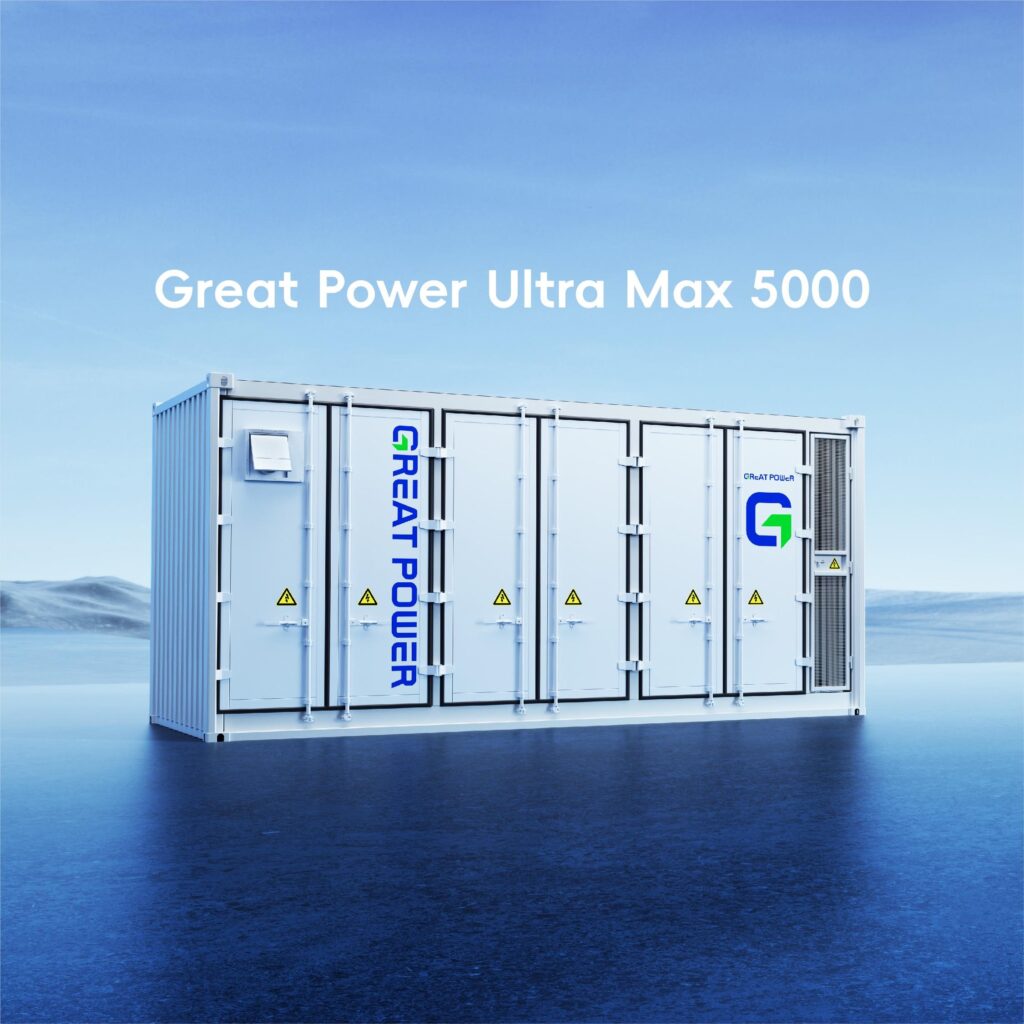
Liquid cooling can also support higher system integration. Great Power’s MAX-20HC-5000, for example, uses a high-safety liquid-cooled PACK within an integrated 20-foot container design. Its published specifications include battery cell efficiency of at least 96% and DC-side round-trip efficiency of 96% at 0.25P and 95% at 0.5P.
Air Cooling: Simplicity and Cost Considerations
Air cooling remains relevant where project requirements do not demand the same level of thermal control. Its architecture is generally straightforward, using fans, ventilation paths, and heat exchangers to move warm air away from battery assemblies.
For some projects, this simplicity can translate into lower initial system costs and easier servicing. Great Power’s AirPack portfolio highlights mature technology, affordable cost, modular application, and maintenance advantages for air-cooled configurations.
However, air cooling can require careful airflow design. Uneven airflow may produce temperature differences within a battery assembly, while fans and ventilation equipment also require consideration for noise, dust, filters, and auxiliary power consumption.
Comparing Liquid-Cooled and Air-Cooled Systems
The best cooling method depends on project needs. Liquid cooling suits high-density applications requiring precise temperature control and compact integration, while air cooling can be practical where simplicity, mature technology, and lower upfront costs are priorities.
Environmental conditions, enclosure protection, monitoring, fire safety, and maintenance should also be considered. For large renewable projects, battery chemistry, power rating, PCS integration, energy management, and safety architecture should be evaluated alongside the cooling system.
Why Liquid-Cooled Energy Storage Containers Are Gaining Attention?
As battery systems become more energy dense, thermal management is becoming increasingly important. Great Power’s large energy storage portfolio includes liquid-cooled container systems such as MAX-20HC-5000 and Max-20HC-6250. The latter uses self-developed 588Ah battery cells, a high-safety liquid-cooled PACK, and a six-level safety protection system for its liquid-cooled energy storage cabinet architecture.
The company also reports liquid-cooled LiqRack configurations with temperature differences within 2°C and a 20% longer cycle life compared with air-cooled systems. These characteristics demonstrate why liquid cooling can be attractive for utility-scale and other demanding applications where consistent thermal performance is a major project consideration.
Choosing the Right Cooling Strategy
There is no universal answer when selecting between liquid and air cooling. Air-cooled systems can make sense for projects prioritizing straightforward architecture and cost control, while liquid-cooled systems are well suited to applications requiring higher thermal consistency and dense system integration.
Project developers should evaluate the expected load profile, local climate, available space, maintenance resources, safety requirements, and lifetime economics before selecting an energy storage container. A detailed assessment of these factors can help ensure that the cooling architecture supports reliable operation throughout the project’s service life.
For large-scale applications, Great Power provides containerized energy storage solutions covering utility-scale and commercial and industrial scenarios, alongside battery cells, packs, racks, and cabinets. Its large energy storage products include integrated liquid-cooled solutions designed for applications such as photovoltaic and wind power generation, peak-valley energy management, and fluctuating loads.
Ultimately, liquid cooling and air cooling should be viewed as different engineering approaches rather than competing technologies with one universal winner. By matching thermal-management technology with system density, operating conditions, and project objectives, developers can select an energy container that delivers a more appropriate balance of performance, safety, cost, and long-term value.