How Does Lecture Room Seating Layout Affect Visibility and Audience Engagement in Lecture Hall Seating?

Seat arrangement affects how clearly attendees see a lecturer, read projected material, and follow demonstrations. Blocked sightlines can make people lean sideways or change posture, distracting them from the presentation. These issues matter when lessons rely on diagrams, figures, or detailed text.

For universities, government training centers, and corporate learning facilities, a practical lecture room seating layout connects room dimensions with screen position, row spacing, aisle access, and furniture design. The aim is to provide usable views and clear routes while supporting interaction.
Sightlines Depend on Height and Screen Position

In a flat-floor room, attendees in rear rows may have their view blocked by people seated in front. Tiered floors or raised platforms can reduce this problem, although the required height difference depends on room geometry and the viewing target. Screen size alone cannot correct every obstruction.

Designers should check views from the front, middle, rear, and side sections. The screen’s lower edge, stage height, and people seated in front all affect visibility. Displays placed too far to one side may require repeated head turning. In wide rooms, additional screens may help attendees read slides without straining.

Row Spacing Affects Movement

The gap between rows influences legroom and how easily people reach their seats. Tight spacing may increase nominal capacity, but it can slow entry and exit during a session. Late arrivals passing seated attendees may interrupt attention, while narrow routes can complicate cleaning and emergency movement.

Planners should account for the occupied chair, desk projection, and space needed to pass. Aisle widths, exits, and wheelchair access must meet local requirements. A practical seating plan provides clear routes into each seating block, with aisle positions based on room width, door locations, and audience size.

Seat Orientation Shapes Participation

Straight rows facing the stage suit formal lectures because they direct attention toward the speaker and shared screen. They also support note-taking and large audiences. However, this format does little to encourage discussion between attendees, who may need to turn around to speak with one another.

Curved or gently angled rows can reduce uncomfortable viewing angles in some wide halls. For interactive classes, instructors need access to different sections, and participants need desk space for laptops and notes. Movable furniture may help with group work, provided it does not block exits or accessible routes.

Furniture Details Matter to Daily Use

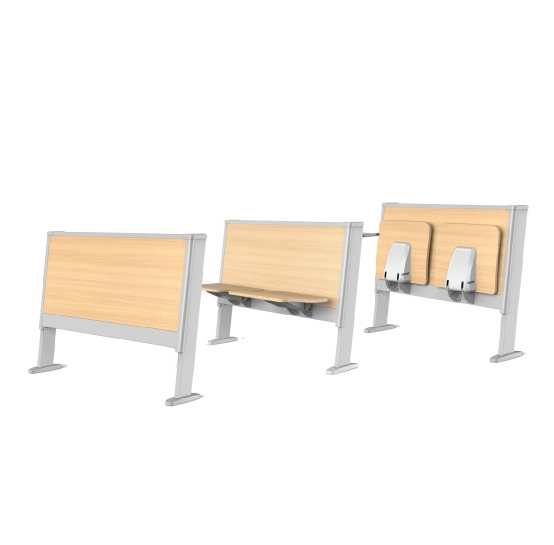
Seat and desk dimensions should be checked before the number of rows is finalized. Fold-down desks can create more clearance as people enter or leave a row, but the mechanism needs adequate space. Fixed desks may suit rooms used mainly for lectures with a consistent seating plan.

One institutional option is the KYLE LS-428 lecture hall desk and chair. It uses a silent spring return mechanism that guides the seat back into position after use. The table top is particle board with a laminate finish and comes in fixed or fold-down configurations. Its front panel is MDF with a laminate finish and aluminum cover.

The seat is made from 16 mm-thick plywood with a laminate finish, while the legs and base use high-quality steel tube with a powder-coated finish. These details help procurement teams compare construction and surfaces against project requirements. Buyers should also check dimensions, installation clearances, cleaning instructions, and intended use before choosing a model.

Sound and Sightlines Need Joint Review

Clear views cannot compensate for poor sound. Attendees seated far from the speaker may struggle if acoustic performance or loudspeaker coverage is uneven. Seating blocks should be reviewed alongside speaker placement and acoustic treatment.

A site walk-through can reveal seats where columns, railings, or display edges obstruct the view. It can test speech clarity at the back and sides. Resolving issues before installation is easier than changing the layout later.

Test the Plan Before Ordering

Project teams should start with a scaled plan showing seats, desks, aisles, doors, accessible spaces, stage boundaries, and screens. They can then review views from the first row, center, rear, and outer sections. This links capacity to actual viewing conditions instead of relying on seat count alone.

Where possible, a sample row or full-size mock-up can help check legroom, desk clearance, seat return, and routes between occupied seats. Teams should consider the room’s main uses, too. Examinations, guest lectures, staff training, and group discussions place different demands on circulation and furniture.

For institutional buyers, Leadcom seating can be included in the supplier review. Leadcom offers project management support throughout the planning, production, logistics, and installation stages. Its website also lists a five-year manufacturer’s limited warranty against manufacturing defects under normal usage, together with lifetime maintenance. Buyers should confirm service scope and warranty terms for the specific project before making a decision.

Base the Final Choice on Real Viewing Conditions

Effective layouts balance sightlines, row spacing, access, and the way a room will be used. Checking views from several seats, reviewing screen angles, and testing movement through occupied rows can expose problems before installation. These checks also help explain why a proposed capacity is suitable.

A suitable layout supports clear viewing and practical movement under real operating conditions. Buyers can compare Leadcom seating with other options by reviewing verified dimensions, materials, service terms, and venue requirements. Final approval should follow checks of visibility, accessibility, and circulation together.


Static vs. Wet Snow Load Ratings: How Much Winter Snow Can a Galvanized Steel Gazebo Roof Actually Support?

Winter can transform a backyard gazebo into a comfortable outdoor retreat, but snow accumulation raises an important question: how much weight can the roof safely support? For homeowners considering hardtop gazebos, understanding snow load ratings is essential, especially in regions with heavy snowfall, freezing temperatures, and repeated winter storms. While galvanized steel roofing offers durability and corrosion resistance, its ability to withstand snow depends on more than the roofing material alone.

What Does a Hardtop Gazebo Snow Load Rating Mean?

A hardtop gazebo snow load rating indicates how much snow weight a structure is designed or tested to withstand under specified conditions. It is commonly expressed in pounds per square foot (psf), describing the load distributed across a roof rather than the total weight of snow in the backyard.

However, a published rating should not automatically be interpreted as a guarantee of safety under every winter condition. Roof design, frame strength, support posts, connections, and installation quality all affect how a gazebo handles accumulated snow.

When comparing hardtop gazebos, look for manufacturer-provided snow load specifications and clarify whether they represent a tested capacity, a design value, or another stated limit. If a product does not publish a verified snow load rating, avoid assuming it can support a particular depth of snow based on appearance alone.

Static Snow Load vs. Wet Snow Load: Why Weight Matters

Snow depth is only part of the equation. Its density and moisture content determine how much weight accumulates on a roof.

Static snow load refers to the weight of snow resting on a structure. Wet snow typically contains more water and is considerably heavier than the same volume of dry, fluffy snow. Consequently, a relatively shallow layer of wet snow may impose a greater load than a deeper layer of light powder.

For example, consider a hypothetical gazebo roof with a verified capacity of 20 psf. A uniform snow layer weighing 15 psf would fall below that stated capacity, while a layer weighing 25 psf would exceed it. These figures illustrate how load ratings work; they are not a recommended operating threshold for any particular gazebo.

The distinction between wet snow vs. dry snow on a gazebo roof becomes especially important during late-winter storms, when rising temperatures cause snow to absorb moisture or partially melt. Refreezing can also create additional ice accumulation. Because snow density varies significantly, there is no universal snow depth that guarantees a gazebo roof will remain within its rated capacity.

Can a Galvanized Steel Gazebo Roof Handle Heavy Snow?

Galvanized steel is steel coated with zinc to help protect against corrosion. This protective layer can help a gazebo roof withstand outdoor exposure, including moisture and changing weather conditions.

However, corrosion resistance and structural load capacity are two different things. A galvanized steel roof is not automatically capable of supporting heavy snowfall simply because the material is strong.

The entire gazebo assembly matters. Roof panels, beams, joints, brackets, posts, and the anchoring system work together to transfer weight safely to the ground. A weakness in any component can affect overall performance. Roof shape and geometry also influence how snow accumulates and distributes across the structure.

When evaluating SUNJOY hardtop gazebos, review the specifications for the specific model you are considering. You can explore available designs in the SUNJOY Hardtop Gazebos collection. For properties in snowy climates, prioritize clearly documented structural information over assumptions based on roof material or appearance.

How to Choose the Best Hard Top Gazebo for Winter

The best hard top gazebo for your backyard depends on local weather, intended use, and the manufacturer’s specifications.

Start by checking local snow conditions and building requirements. Areas that experience frequent heavy snowfall may require more careful structural evaluation than regions with occasional light snow. Remember that local design snow loads are not necessarily equivalent to a consumer gazebo’s rated capacity.

Next, review the product documentation. Look for an explicit snow load rating, installation instructions, anchoring requirements, and guidance on winter maintenance. If the rating is unavailable or unclear, contact the manufacturer before purchasing.

Consider roof design and drainage as well. A roof that sheds snow differently from another design may experience different load patterns, but no shape should be assumed safe without supporting specifications. Proper assembly on a stable, suitable foundation is equally important.

Finally, understand the manufacturer’s winter-use guidance. Some gazebos may require snow removal or seasonal precautions. Follow the instructions for your specific model rather than relying on general assumptions about steel construction.

Practical Winter Care for Your Gazebo

Regular winter checks can help identify accumulating snow, ice buildup, loose connections, or visible structural changes. Follow the manufacturer’s recommendations for snow removal and never climb onto a snow-covered gazebo roof unless the manufacturer explicitly provides a safe procedure.

If snow accumulation approaches a stated limit, or you notice bending, unusual movement, or other signs of structural distress, keep people away from the structure and seek appropriate professional guidance. Do not wait for visible damage before taking winter conditions seriously.

Make an Informed Choice for Every Season

A galvanized steel roof can offer durability and corrosion protection, but the amount of winter snow a gazebo can support depends on its complete structural design and verified load rating. Understanding the difference between static load and the added weight of wet snow helps homeowners make better purchasing and maintenance decisions.

Before choosing among SUNJOY hardtop gazebos, compare model-specific specifications, consider your local winter conditions, and follow the manufacturer’s guidance. With realistic expectations and proper care, you can select an outdoor shelter that better suits your backyard and seasonal needs.

How Central Bank Policy Differences Influence Forex CFDs and Currency Pair Trends

Central banks play an important role in shaping foreign exchange markets. When major central banks move in different directions on interest rates, inflation, or monetary policy, currency valuations can respond as investors reassess the relative attractiveness of different economies. For traders using a forex trading platform, understanding these policy differences can provide useful context for interpreting movements in major currency pairs and managing the risks associated with forex CFDs.

Currency Pair Trends

Why Central Bank Policies Matter to Currency Markets

Interest rates are closely connected to currency valuations because they influence the potential return available from assets denominated in a particular currency. When one central bank maintains a relatively higher interest rate while another moves toward lower rates, the difference can affect capital flows and market expectations.

Historical research from the Federal Reserve and other institutions shows that changes in interest rate differentials can influence exchange rates, although the relationship is not always consistent or immediate.

For example, if expectations for US interest rates rise relative to those in another major economy, traders may reassess the outlook for USD pairs. However, the actual currency response depends on what the market had already priced in. A widely anticipated rate decision may produce limited movement, while an unexpected change in policy expectations can generate a much stronger reaction.

This distinction is particularly relevant when trading forex CFDs, where leverage can magnify both gains and losses.

Understanding Policy Divergence Through Major Currency Pairs

Central bank divergence is best understood through relative rather than isolated policy changes. A currency pair always represents the value of one currency against another, so traders need to consider the monetary policy outlook on both sides.

For EUR/USD, for instance, traders may monitor expectations surrounding the Federal Reserve and European Central Bank. For GBP/USD, the Bank of England becomes another important factor, while USD/JPY requires close attention to both US monetary policy and the Bank of Japan.

The key question is not simply whether a central bank is raising or cutting rates. Traders also need to consider the expected pace, duration, and future path of policy.

Market expectations can change before an official decision. Economic data such as inflation, employment, consumer spending, and economic growth may alter expectations about future interest rates. As a result, currency prices can move substantially before a central bank actually announces a policy change.

What Traders Should Watch Before a Policy Decision

A practical approach is to monitor the information that can change expectations rather than focusing exclusively on the central bank announcement itself.

Inflation data can influence expectations about whether monetary policy may remain restrictive or become more accommodative. Employment figures can provide clues about economic resilience and potential policy pressure. Central bank statements, meeting minutes, and speeches can also offer information about policymakers’ views.

The market’s expectation before an announcement is equally important. If traders already expect a rate cut, the announcement itself may have a limited effect. A larger move may occur if the central bank provides guidance that differs significantly from expectations.

For users of a forex trading platform, this means economic calendars and real time price information can be useful complements to technical analysis. The objective is not to predict every central bank decision, but to understand which developments could change the market’s expectations.

How This Relates to Forex CFDs

Forex CFDs allow traders to speculate on currency price movements without taking direct ownership of the underlying currencies. Because these products are traded on margin, leverage can increase exposure to relatively small price movements.

This makes risk management especially important around major monetary policy announcements. A sudden change in interest rate expectations can produce rapid price movements, wider spreads, or increased volatility.

GTCFX provides access to more than 70 currency pairs through its forex trading offering, including major, minor, and exotic pairs. Its platform options include MT4, MT5, and the GTC Go application, allowing users to monitor markets across desktop, web, and mobile environments.

The company also states that its forex offering provides real time bid and ask prices, ECN execution, and access to liquidity across its currency markets. Trading conditions can vary by account, jurisdiction, and applicable entity, so traders should review the relevant terms and risk disclosures before using forex CFDs.

Policy Divergence Is Only One Part of the Picture

Central bank divergence can help explain some currency movements, but it should not be treated as a standalone indicator. Exchange rates are also influenced by economic growth, inflation expectations, commodity prices, geopolitical developments, market sentiment, and risk premiums.

Leveraged carry trades can amplify exchange rate movements when investors rapidly unwind positions in response to changing interest rate expectations or market risk.

This explains why a currency may sometimes move differently from what a simple interest rate comparison would suggest. When market positioning changes rapidly, the unwinding of existing positions can add another layer of volatility.

Making Better Use of a Forex Trading Platform

For traders analyzing forex CFDs, central bank divergence can serve as a framework for understanding the broader market environment. Instead of looking at a rate decision in isolation, traders can compare the monetary policy outlook of both currencies, examine current economic data, and consider what expectations may already be reflected in prices.

A forex trading platform such as GTCFX can provide access to currency pairs, charts, pricing, and trading tools in one environment. However, the availability of tools does not remove market risk. GTCFX specifically warns that leveraged FX and CFDs are complex products that can result in rapid losses and that past performance does not indicate future results.

For this reason, understanding the relationship between monetary policy and currency prices should go together with appropriate position sizing, risk controls, and awareness of leverage.

A More Structured Approach to Currency Analysis

Central bank divergence offers traders a useful way to organize fundamental analysis. The most important consideration is the relative direction of monetary policy and how that direction compares with existing market expectations.

By combining central bank guidance with economic indicators, market pricing, technical analysis, and disciplined risk management, traders can develop a more complete view of potential currency market scenarios. For anyone using forex CFDs, this broader perspective is particularly important because leverage can make short-term price movements more consequential.

GTCFX provides access to major, minor, and exotic currency pairs through its forex trading platform, giving traders a range of instruments for monitoring global currency markets.

5 Signs You Need to Upgrade Your Energy Containers

Energy containers have become an important solution for large-scale electricity management, renewable energy integration, and industrial power applications. These systems help store electricity, improve energy

Utility Scale Battery Storage for Microgrid Resilience

Energy infrastructure requires robust solutions to maintain stability amid increasing reliance on intermittent renewable generation. Modern grid architectures demand sophisticated, reliable assets that provide power